AI for Banking & Finance Practices
The Manual Monitoring Problem
That is how many facilities one banking team was tracking in spreadsheets and emails when they came to us. Key dates scattered across personal calendars. Covenant tests rebuilt manually each quarter. No portfolio-level view of risk. This is not unusual - it is the norm across most banking practices in the UK and globally.
The banking and finance legal market is caught between two pressures. From above, the FCA and PRA are demanding more rigorous monitoring, faster reporting, and better audit trails. From below, fintech companies like Wayflyer, ThinCats, and the direct lending platforms are building their own compliance infrastructure and questioning why they need a law firm to tell them whether a covenant has been breached.
The work itself has not changed much in 20 years. A banking associate still reads a facility agreement, identifies the covenants, requests the borrower's financials, and manually tests compliance. The spreadsheet gets emailed to the partner. The partner emails the client. If there is a breach, everyone scrambles. If there is not, the spreadsheet goes in a drawer until next quarter.
This process does not scale. A mid-market banking team managing 200 facilities cannot manually test covenants across all of them every quarter. They triage - testing the ones they think are highest risk and hoping the rest are fine. That is not risk management. That is gambling with a professional indemnity policy.
The firms building automated monitoring platforms are not just faster. They are more thorough. They test every covenant, every quarter, across every facility. And they give the client a dashboard that shows portfolio health in real time - not a spreadsheet that arrives three weeks late.
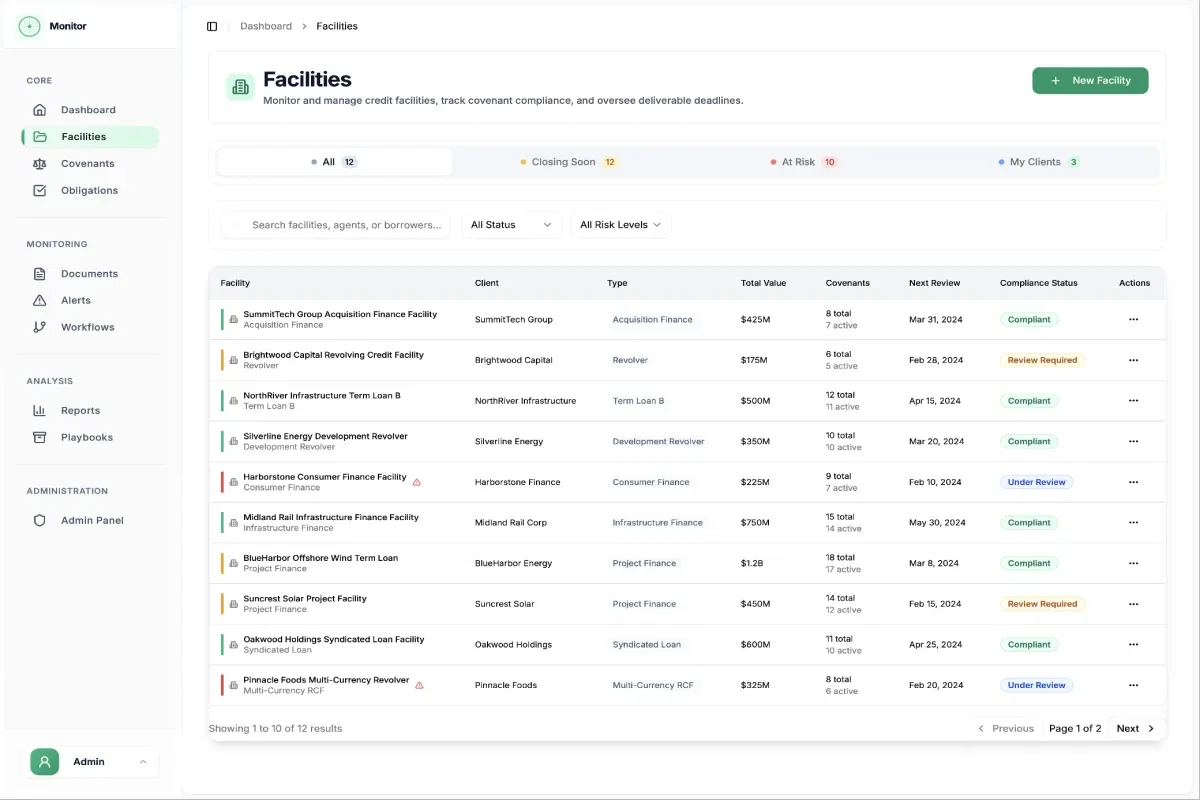
Facility Covenant Monitoring
A shared lawyer/client platform that structures loan covenants, automates deliverables and compliance tests, and alerts lawyers and clients to upcoming deadlines or breaches with built-in workflows and audit trail
View full case studyThe leveraged lending market is shifting structurally. Direct lenders are taking market share from traditional bank syndicates, bringing different documentation standards and faster execution expectations. CLO managers are demanding better data on underlying portfolios. And the Basel III endgame reforms are pushing banks to be more rigorous about credit risk monitoring.
For law firms, this means three things. First, the volume of facility documentation is increasing while fee pressure on monitoring work is intensifying. Second, clients expect technology-enabled service delivery as standard - the lender who gets a quarterly PDF report while their competitor gets a real-time dashboard will switch firms. Third, regulatory scrutiny of covenant monitoring practices is tightening, making the "we check the important ones" approach increasingly untenable.
The firms that invest in automated monitoring infrastructure now are positioning themselves for the next decade of banking work. The firms that do not are building a practice on a foundation that regulators, clients, and competitors are all undermining simultaneously.
5 Predictions: How AI Will Reshape Banking & Finance Legal Practice by 2029
Continuous covenant monitoring will become the minimum client expectation
Quarterly manual testing will be seen as negligent by 2029. Institutional lenders and CLO managers will require real-time monitoring with automated breach alerts as a condition of instructing a law firm. Firms without this capability will lose mandates to firms that have it.
AI will restructure the economics of facility agency work
The administrative burden of agency work - tracking conditions precedent, managing drawdown mechanics, monitoring compliance - will be largely automated. This will compress fees for routine administration but create premium pricing opportunities for the advisory layer on top.
KYC and AML compliance will be fully automated for standard counterparties
AI-powered screening against sanctions lists, PEP databases, and adverse media will become instantaneous. The compliance team's role will shift from running checks to reviewing exceptions flagged by the system. Firms that offer this as a client-facing service will create a new revenue stream.
Loan documentation will be analysed by AI before any lawyer reads it
The first review of a facility agreement - extracting key terms, mapping conditions precedent, identifying unusual provisions - will be done by AI as standard. Lawyers will start from a structured analysis rather than a blank document. This will halve the time for initial review and fundamentally change how junior associates are deployed.
Syndicated lending platforms will require API integration with law firm systems
The major lending platforms - Finastra, IHS Markit, LSTA - will expect law firms to push compliance data directly from their monitoring systems. Manual reporting will become a friction point that drives clients away. The firms with integrated platforms will have a structural advantage.
AI-Powered Covenant Testing, Facility Monitoring & Loan Documentation Analysis
Automated Facility Covenant Testing
AI that monitors loan covenants continuously, runs compliance tests automatically against borrower financials, and flags breaches early. Replaces quarterly manual rebuilds with real-time portfolio oversight across every facility, not just the ones the team has time to check.
AI-Powered KYC & AML Screening
Automated client due diligence that screens against sanctions lists, PEP databases, and adverse media in seconds. Structured output for compliance officers with audit trails and risk scoring. Updated continuously as watchlists change, not just at onboarding.
Loan Documentation Analysis & CP Tracking
AI extraction of key terms, conditions precedent, drawdown mechanics, and amendment histories across facility agreements. Lawyers get structured data and a living conditions tracker instead of reading hundreds of pages to find the clause that matters.
Regulatory Change Impact Assessment
Automated monitoring of FCA, PRA, and Basel regulatory changes with AI analysis of impact on existing facilities, client portfolios, and compliance obligations. Early warning system that maps regulatory developments to specific client positions.
What We've Learned Building for Banking & Finance
When we built the covenant monitoring tool, the hardest part was not the AI - it was getting the banking team to trust automated compliance testing over their spreadsheets. We solved this by running both systems in parallel for a quarter and showing the automated system caught three issues the manual process missed. Trust is earned through evidence, not demos.
The biggest mistake firms make with banking AI is trying to automate everything at once. Start with one facility type, one covenant structure, and prove it works. Then expand. We have seen three firms stall because they tried to build a universal monitoring platform on day one. The ones that succeeded started with a single syndicated facility and grew from there.
Clients care about the audit trail more than the automation. Every automated covenant test needs to show exactly which clause it tested, which financial data it used, and what the result was. If a regulator asks, the client needs to point to a clean trail - not "the AI said it was fine." We built the audit layer first and the intelligence layer second.
The unexpected win was client retention. One firm told us that their automated monitoring dashboard was mentioned by name in three pitch presentations by the client's treasury team. The tool became a reason to keep the firm on the panel, independent of the quality of the legal advice.
Can AI really automate covenant testing for complex facilities?
Yes, for structured covenants with clear financial tests - which covers the majority of banking work. The AI extracts the covenant formula from the facility agreement, maps it to the borrower's financial data, and runs the test. It flags ambiguities for human review rather than guessing. We have deployed this for facilities with 15+ covenants per agreement, including leverage ratios, interest cover tests, and cashflow sweep mechanics.
How does AI-powered facility monitoring integrate with existing workflows?
It sits alongside your existing systems, not replacing them. The platform ingests facility data from your DMS and financial data from borrower submissions. Lawyers review flagged issues in a dashboard rather than rebuilding spreadsheets. Most teams see a 60-70% reduction in manual monitoring time within the first quarter. The system integrates with iManage, NetDocs, and the major DMS platforms.
What is the ROI on automated covenant monitoring?
The direct time saving is significant - typically 3-5 hours per facility per quarter in reduced manual review. But the real ROI is in risk reduction and client retention. Automated monitoring catches issues earlier, reduces the risk of missed deadlines, and gives clients the continuous oversight they are increasingly demanding. One firm estimated the tool paid for itself in retained mandates within the first year.
How does this work for syndicated facilities with multiple agent banks?
The platform handles multi-party structures by mapping each participant's obligations and entitlements separately. The facility agent sees a consolidated view while each syndicate member sees their position. Compliance data flows upstream to the agent and downstream to participants automatically. This is where the tool adds the most value - manual coordination across a syndicate is where most monitoring failures occur.
What about private credit and direct lending facilities?
Direct lending documentation is often less standardised than syndicated facilities, which means the AI extraction layer needs to be more flexible. We train the system on the firm's specific precedent library and common documentation sets from sponsors like Ares, Blackstone Credit, and the mid-market direct lenders. The monitoring logic adapts to bespoke covenant structures rather than assuming LMA standard form.