AI for Corporate & M&A Practices
A partner at a top UK firm described their due diligence process to us: "We send 8 associates into a data room for two weeks. They read everything. They build a spreadsheet. Then I read the spreadsheet and ask them questions about the 5% that actually matters. It is the most expensive way to find a needle in a haystack."
That conversation is not unusual. It is how almost every corporate practice in the UK still runs due diligence. The data room has moved from physical to virtual, but the process has not changed since the 1990s. Lawyers read documents sequentially, note issues in spreadsheets, and hope that the person reading contract 847 at midnight on day twelve is as sharp as the person who read contract 1 at 9am on day one.
Meanwhile, Harvey AI is being deployed at Allen & Overy. Luminance has raised over $100m and is marketing directly to corporate clients. Kira Systems was acquired by Litera and is embedded in due diligence workflows at dozens of global firms. The question is no longer whether AI will change M&A due diligence. It is whether your firm will build something distinctive or rely on the same tools everyone else has.
The firms we work with are choosing to build proprietary tools because they understand that a generic AI assistant gives every firm the same output. A proprietary due diligence agent trained on your precedent library, your risk taxonomy, and your client reporting format gives you something competitors cannot replicate.
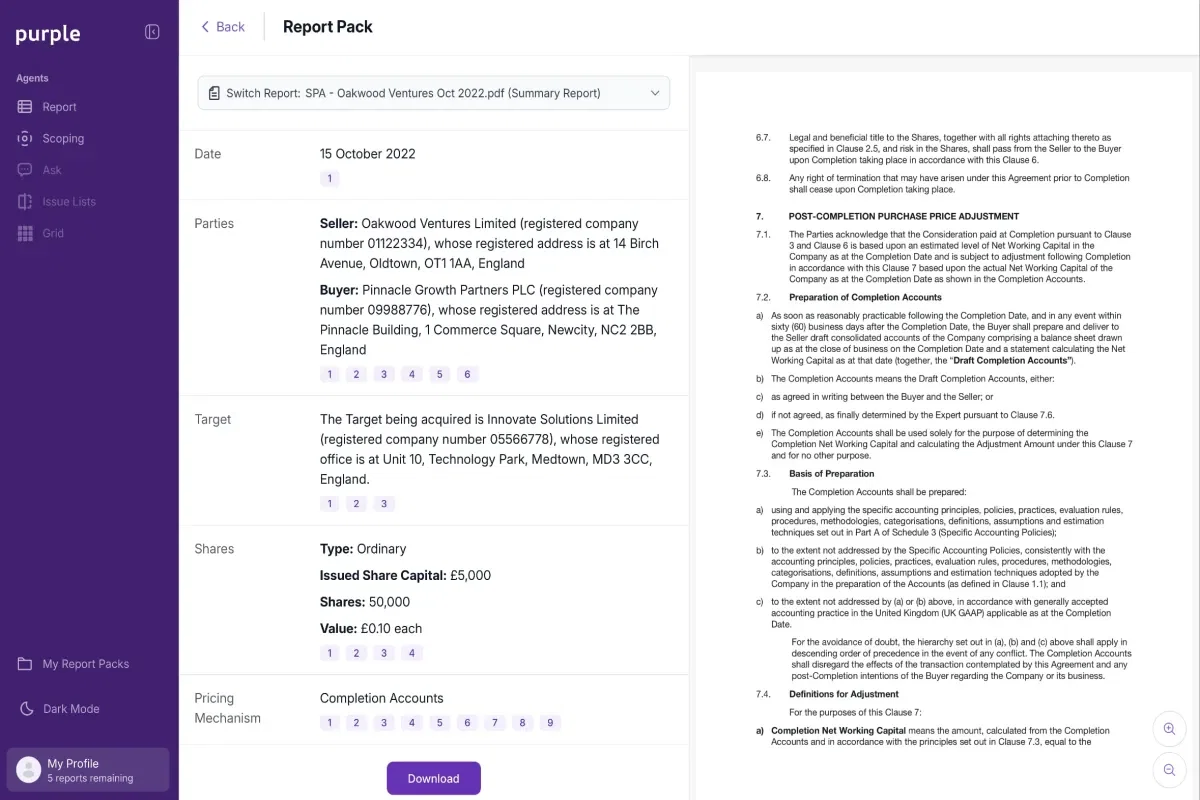
M&A Due Diligence Agent
An agentic AI that enters the data room, maps the deal's people and paper into a living knowledge graph, and drafts an instant, client-specific due diligence report — so lawyers see the real risks and scope on day one.
View full case studyThe M&A market is bifurcating. At the top end, deal values and complexity continue to increase, but clients are pushing back on the cost of large associate teams doing manual document review. PE sponsors running programmatic acquisition strategies want faster, more consistent diligence at lower cost. They are starting to ask in beauty parades what AI tools the firm uses.
At the mid-market level, the pressure is different but equally acute. Deals are more competitive, timelines are shorter, and the margin on diligence work is shrinking. Firms that can deliver a first-read report within 48 hours of data room access have a genuine competitive advantage over firms that need two weeks.
The technology landscape is also shifting. The era of simple keyword search and clause extraction is over. The next generation of M&A AI tools use knowledge graphs to map relationships between parties, contracts, and obligations across the entire deal. They do not just find individual clauses - they identify patterns, connections, and risks that span multiple documents and jurisdictions. This is where the real value lies, and it is where proprietary tools built on firm-specific expertise pull ahead of generic platforms.
5 Predictions: How AI Will Reshape Corporate M&A Practice by 2029
First-read diligence reports will be AI-generated as standard
By 2029, no serious M&A practice will send associates into a data room without an AI-generated first read. The initial mapping of parties, key contracts, risk areas, and change-of-control triggers will be automated. Associates will start from a structured analysis, not a blank spreadsheet. Firms without this capability will not make shortlists for competitive mandates.
Knowledge graphs will replace document-by-document review
The linear approach of reading contracts one at a time will give way to graph-based analysis that maps the entire deal as an interconnected structure. Lawyers will navigate the deal as a network of relationships - seeing that a change of control in Company A triggers consent requirements in Contracts B, C, and D across three jurisdictions. This changes how risk is identified and how reports are structured.
PE sponsors will mandate AI-assisted diligence in engagement terms
The larger private equity houses are already asking about AI in beauty parades. Within three years, they will require it contractually - specifying that initial document review be AI-assisted and that the firm provide structured data outputs compatible with the sponsor's portfolio management systems. Firms that cannot meet these requirements will lose PE mandates.
Deal benchmarking will become a competitive weapon
Firms that build structured databases of historical deal terms - pricing, protections, representations, and warranty packages - will offer something no generic AI tool can match. Partners will negotiate with data: "This indemnity cap is in the bottom quartile of comparable mid-market deals we have seen in the last 18 months." That changes the negotiation dynamic entirely.
Post-completion AI will be worth more than pre-completion AI
The biggest untapped opportunity in M&A AI is not due diligence - it is post-completion. Tracking conditions subsequent, integration milestones, earn-out triggers, and warranty claim deadlines across a portfolio of acquisitions is manual, error-prone, and high-risk. The firm that automates this becomes indispensable to serial acquirers.
AI-Powered Data Room Analysis, Deal Intelligence & Post-Completion Tracking
Agentic Due Diligence
AI agents that enter the data room, map the deal into a knowledge graph of parties, contracts, and obligations, and produce issue-flagged diligence reports with direct clause citations. Lawyers see the real risks on day one, not week three. Trained on the firm's risk taxonomy and reporting format.
Change of Control & Assignment Analysis
Automated identification of change of control triggers, consent requirements, and assignment restrictions across hundreds of contracts simultaneously. Finds the cross-contract connections that sequential review misses. The analysis that used to take a team a week runs in minutes.
Deal Intelligence & Term Benchmarking
AI that extracts and structures key deal terms across historical transactions, building a firm-specific benchmarking database. Partners negotiate with data - comparing pricing, protections, and market positions against comparable deals in real time.
Post-Completion Obligation Tracking
Automated monitoring of post-completion obligations, conditions subsequent, earn-out triggers, and integration milestones across a client's acquisition portfolio. Structured workflows with automated alerts replace the spreadsheets that serial acquirers and their lawyers currently rely on.
What We've Learned Building for Corporate & M&A
In M&A due diligence, the AI is not replacing the lawyer's judgement - it is giving them the full picture on day one instead of week three. The biggest value is not speed. It is the risks you catch that you would otherwise have missed because a junior associate was reading their 400th contract at 11pm. We built the tool after a firm told us they missed a material change-of-control trigger buried in a supply agreement in the data room. It cost the client seven figures.
Knowledge graphs are the breakthrough technology for deal analysis, not large language models alone. Mapping the relationships between parties, contracts, and obligations reveals patterns that no amount of document-by-document review would surface. A change of control in Entity A triggers consent requirements in a contract held by Entity B's subsidiary in a different jurisdiction. That connection is invisible in a spreadsheet. It is obvious in a graph. We built three versions before we got the graph structure right.
Partners do not care about the technology. They care about two things: can I trust the output enough to show it to a client, and does it make my associates more useful or less useful? The answer needs to be both - trustworthy and empowering. We learned to stop demoing the AI and start demoing the report it produces. When the partner saw a client-ready risk matrix with clause citations, they understood. When we showed them the knowledge graph, their eyes glazed over.
The most underestimated use case is repeat acquirers. A PE sponsor doing 15 bolt-on acquisitions a year needs consistency across diligence reports, and they need to track post-completion obligations across the entire portfolio. The tool that does this becomes embedded in the sponsor's workflow - and the firm that provides it becomes very hard to replace.
How does AI due diligence handle complex multi-jurisdictional deals?
The AI maps documents regardless of jurisdiction but flags jurisdiction-specific issues for local counsel review. It is particularly strong at identifying cross-border connections - for example, finding that a change of control in one jurisdiction triggers consent requirements in three others. The knowledge graph structure makes these connections visible in ways that linear document review cannot. We have deployed this on deals spanning 12+ jurisdictions.
Can AI really produce a reliable first-draft diligence report?
Yes, for structured risk identification and clause extraction. The AI produces a report organised by risk category with direct citations to source clauses and a red/amber/green severity rating. It does not make judgement calls about materiality - that is still the lawyer's job. But it gives them a comprehensive, structured starting point instead of a blank page. Partners tell us the first-read report is typically 80% of the way to a final client deliverable.
How does this compare to Harvey, Luminance, or Kira?
Generic AI platforms give every firm the same output. They are good at clause extraction and document classification. What they do not do is produce reports in your firm's format, apply your risk taxonomy, or map relationships between entities and contracts in ways that match how your partners think about deals. A proprietary tool trained on your precedent library and deal history produces output that is distinctively yours. That is the difference between a commodity tool and a competitive advantage.
What is the typical ROI on AI due diligence tools?
The direct saving is 40-60% reduction in associate time on first-pass review. But the strategic ROI is larger: faster turnaround wins competitive mandates, better risk identification reduces client claims, and deal benchmarking data creates a knowledge asset that compounds over time. One firm estimated that winning two additional mandates in the first year - attributed to their AI capability in pitch presentations - covered the entire build cost.
How long does it take to build a proprietary due diligence agent?
A working prototype that processes a data room and produces a structured report takes 8-10 weeks. A production-grade system with knowledge graph mapping, multi-jurisdictional support, and integration with your DMS takes 4-6 months. We start with a discovery sprint using a real historical deal to prove the concept before committing to a full build.
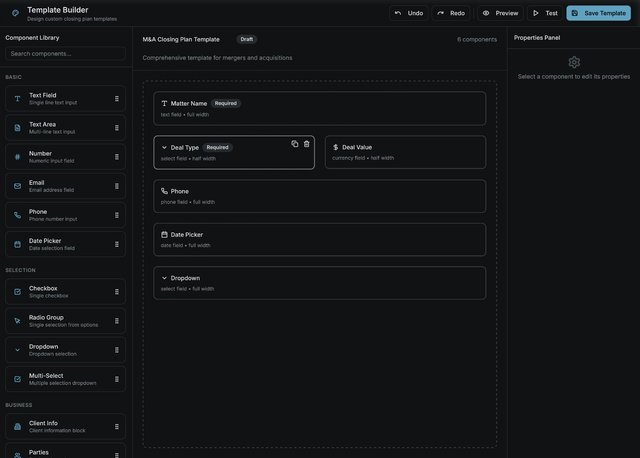
Pathway
A lightweight legaltech tool that reads your deal pack, extracts key obligations using AI, and drafts a client-ready closing plan in minutes.
View full case study