Fast-Growing Specialist Practice
A growing law firm had plenty of AI ideas but no way to tell which ones were worth doing. Partners were stretched thin, previous technology investments had flopped, and services were still entirely bespoke. They needed someone to separate the signal from the noise.
They did not need another strategy deck full of possibilities. They needed a ranked list of what to build, a plan for how to build it, and a clear strategic decision on the direction of the firm.
We did not rely on guesswork. We followed a rigorous process to separate hype from reality.
We taught the leadership team the fundamentals of AI and product. What is real, what is hype, and how it actually applies to law.
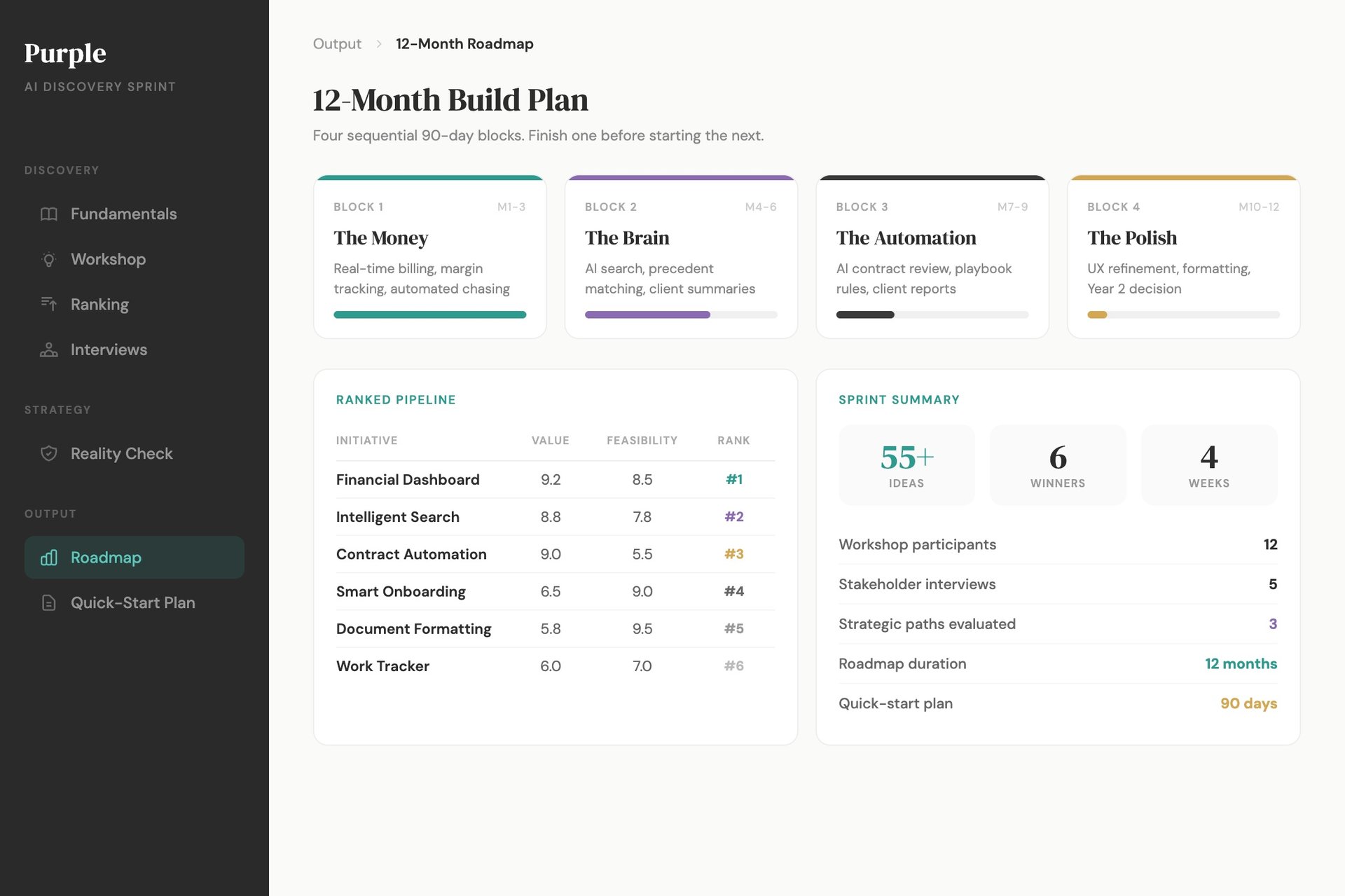
A collaborative session that generated 55+ specific ideas to improve billing, client service, and legal efficiency.
Every idea scored against two criteria: how much value does it create, and how hard is it to build? This killed the low-value projects immediately.
One-on-one conversations with partners and fee earners to validate assumptions and understand the daily friction points.
A strategy session with senior leadership to make a hard decision on business model and risk appetite. No hedging.
The discovery process surfaced three distinct ways to grow the firm. We sat down with senior leadership for a frank strategy session and weighed each option against real-world constraints: time, resources, and risk appetite. The decision was unambiguous.
Keep the current model but make it a significantly better version of itself. Use tech to strip out waste, boost margins, and deliver faster service.
Build a product engine to handle routine work on a subscription basis. Shifts toward recurring revenue.
The platform approach, but focused on one specific sector. Stop being generalists and dominate a niche.
Visible improvements in 3-6 months, not two years.
Does not pull the best lawyers away from their clients.
No bet-the-firm risk. Makes the current model work better.
Walk before you run. Build the foundation first, then decide.
Most firms buy separate tools for separate problems. This is a mistake. It forces lawyers to switch tabs all day and creates data silos. We designed one unified platform that handles everything.
Real-time billing, margin tracking, and automated chasing.
AI search across all files, precedent matching, and client summaries.
AI contract review against the firm's own rules. Client-ready reports.
One-click formatting and branding. Everything looks professional.
Digital onboarding. Scope, budget, and timeline captured before work starts.
Task management linked to billing. Who is doing what, and when.
We finish one block before starting the next. Useful tools shipping every 90 days. We measure success by business results, not lines of code.
Connect the billing system. Give every lawyer a real-time view of what they are billing, what is outstanding, and where they are losing margin. Fix the cash flow first.
Add intelligent search. Lawyers can instantly access the firm's collective knowledge - client context, precedents, and similar matters - without digging through email.
Build an AI-powered review tool. Upload a document, the system checks it against the firm's specific rules, and produces a client-ready report in minutes.
Refine the best features, integrate formatting tools, expand the automation. Use the data gathered to prepare the platform for its next phase of growth.
No real-time view of cash. Invoices take too long. Chasing late payers is manual.
Reduce days sales outstanding by 15-20 days. Improve gross margin by 2-4%.
The firm's knowledge is trapped in individual inboxes. Lawyers waste time re-solving problems already solved.
Save 2-3 hours per lawyer per week. Junior lawyers up to speed in minutes, not days.
Reviewing routine contracts is low-margin, boring, and hard to delegate safely.
Reduce review time from 2 hours to 20 minutes. Consistent quality every time.
Not a strategy document that sits on a shelf. A set of practical tools the firm used to start building the next week.
2-3 measurable goals and success metrics. One page. No waffle.
5-7 short briefs - problem, users, value, acceptance criteria. Each one a page.
Single table scoring every idea on value, feasibility, and adoption. The kill list and the build list.
Conservative estimates per use case. Hours saved, cost avoided, revenue potential.
Four 90-day blocks. Each one builds on the last. Milestones, KPIs, and investment view.
Actions, owners, and success thresholds for the top priorities. Ready to go on day one.
Do not think of this as "just fixing operations." This is the difference between a firm that runs on chaos, email, and heroics, and a firm that runs on a scalable platform.
From the roadmap report delivered to firm leadership
Leadership chose their path based on evidence, not speculation. The build started the following month.
Every idea scored on value and feasibility. The low-value projects were killed immediately.
Leadership made a hard call on business model. No hedging, no "let us revisit this next quarter."
The 90-day quick-start plan meant the firm was writing code within four weeks of the engagement ending.
The roadmap keeps the door open for a platform pivot. Year two decision based on real data, not hope.
We help law firms cut through the hype, rank what matters, and build a roadmap that actually gets executed. Four weeks from kickoff to a plan you can act on.